📝Why you keep forgetting der, die, das — and how to fix it
Sep 22, 2026
Still Forgetting DER, DIE, DAS?
You learn the rule.
You understand it.
You practise it.
And then you're having a conversation and suddenly...
Is it der, die or das?
👉 You guess.
👉 You hesitate.
👉 You start second-guessing yourself.
If this sounds familiar, you're certainly not the only German learner who struggles to turn grammar knowledge into confident speaking.
Learning another long list of rules isn't necessarily the answer.
Often, what helps is learning German articles in a clearer, more structured way from the beginning—and then practising them consistently.
In This Article, You'll Discover:
- ✔️ why DER, DIE and DAS can be difficult to remember
- ✔️ common learning habits that make German articles harder than necessary
- ✔️ why I recommend learning every new noun together with its article
- ✔️ how patterns, colours and plural forms can give your vocabulary more structure
- ✔️ how to move from recognising an article to actually using it
- ✔️ how one of my students, Eva, built her German foundation from scratch using this approach
Let's turn DER, DIE, DAS from something you guess into something you learn with a system. 🌿
Why Do You Keep Forgetting DER, DIE, DAS?
From my experience teaching German, I see three common problems.
1. You Learned the Noun Without the Article
Perhaps your vocabulary list looked like this:
Tisch = table
Lampe = lamp
Buch = book
Then later you discovered that you also needed to know:
🔵 der Tisch
🔴 die Lampe
🟢 das Buch
Now you effectively have to go back and add information to vocabulary you've already learned.
There is a simpler habit:
Learn the article as part of the noun from the beginning.
Don't learn Tisch.
Learn der Tisch.
2. You Learned Lots of Rules Without a Clear System
Organise what you learn.
- Look for useful patterns.
- Group similar nouns.
- Use clear examples.
- Then practise them.
The goal isn't to memorise every German noun at once.
It's to develop a system you can continue using as your vocabulary grows.
3. You Understand the Rule — But Don't Use It Enough
Recognising:
🔴 die Wohnung
on a worksheet and using it spontaneously in conversation are different stages of learning.
Once you've learned a new noun, put it into a simple sentence:
Die Wohnung ist schön. = The apartment is pretty.
Or ask a question:
Ist die Wohnung hell? = Is the apartment bright?
Now you're no longer simply looking at vocabulary.
You're using it.
And that brings me to something I've seen repeatedly during more than 11 years of teaching German.
What 11+ Years of Teaching Have Shown Me
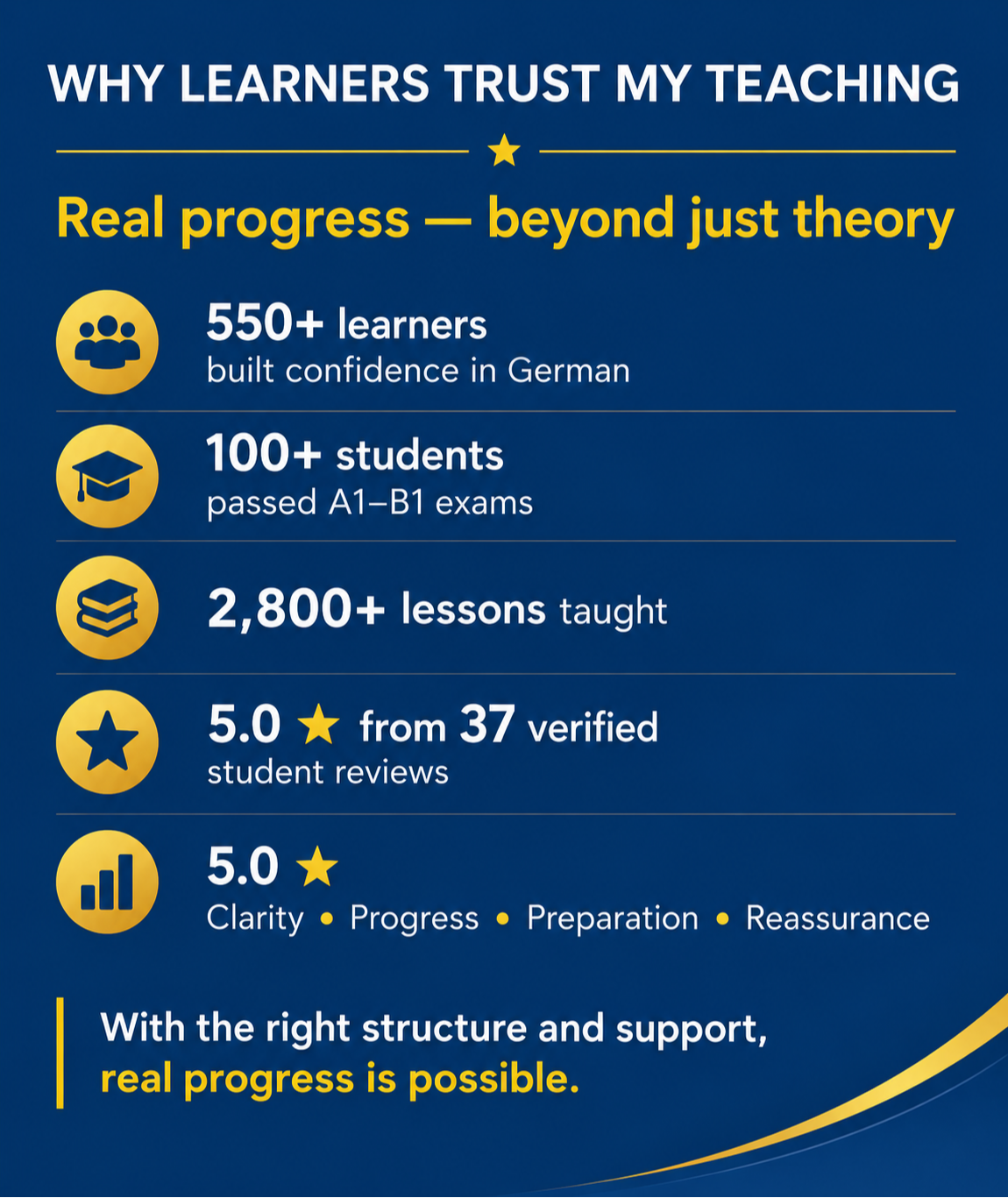
Over more than 11 years of teaching German learners from around the world, I've seen how much difference a strong foundation can make.
My approach is not to overwhelm learners with everything German grammar has to offer at once.
Instead, we build step by step:
understand → organise → practise → apply.
A learner understands the concept.
Then we give it structure.
Then we practise it.
And finally, we use it in sentences, questions, conversations and writing.
This is particularly important with DER, DIE and DAS because articles don't exist in isolation. They become part of the German grammar you build on later.
And one of my students illustrates this approach especially well.
Eva's Story: Building German from the Beginning 🌿
When Eva started learning German with me, she was beginning from scratch.
German was new, and—as many beginners discover—there was suddenly a lot to learn.
So we didn't try to tackle everything at once.
We started with the foundation.
First, we built simple sentences and questions.
Whenever Eva learned a new noun, she didn't learn the noun alone.
She learned:
article + noun
and, where useful,
article + noun + plural
For example:
🔵 der Tisch → die Tische
🔴 die Lampe → die Lampen
🟢 das Buch → die Bücher
🔵 der Tisch → die Tische = the table → the tables
🔴 die Lampe → die Lampen = the lamp → the lamps
🟢 das Buch → die Bücher = the book → the books
We also used colours as visual cues:
🔵 DER
🔴 DIE
🟢 DAS
⚫ DIE → Plural
This gave her vocabulary a consistent structure from the beginning.
As we continued, new vocabulary and grammar could build on that foundation rather than treating the article as an extra piece of information added later.
⭐ Eva's Testimonial

Eva's journey is a good reminder that you don't have to learn everything at once. A clear foundation gives you something to build on.
The Shift: Stop Trying to Remember Everything
If you keep forgetting DER, DIE and DAS, don't respond by simply trying to memorise more.
Instead ask:
How can I give what I'm learning more structure?
Patterns are one part of the answer.
But so are learning the article with the noun, adding the plural, using colours and applying vocabulary in sentences.
Let's make that practical.
Here are five practical changes you can make.
Fix #1: Learn Every New Noun with Its Article
This is the most important habit I would start today.
❌ Tisch
✅ der Tisch = the table
❌ Arbeit
✅ die Arbeit = the work
❌ Büro
✅ das Büro = the office
Think of the article and noun as belonging together.
When you write vocabulary cards or notes, keep them together too.
Fix #2: Learn Patterns Instead of Guessing
German noun genders aren't completely random.
There are useful endings and categories that can give you clues.
For example:
🔴 -ung → DIE
die Wohnung = the apartment
die Rechnung = the invoice
die Besprechung = the meeting, the discussion
🟢 -chen → DAS
das Mädchen = the girl
das Brötchen = the roll, the small bread
🔵 -ismus → DER
der Tourismus = the tourism
der Optimismus = the optimism
These patterns won't remove every exception from German, but they give you something much more useful than random guessing:
a strategy.
Want to explore the patterns and common misconceptions in more detail?
I've written a separate guide devoted to exactly that:
👉 Myths and Facts on the Genders of German Nouns: DER, DIE, DAS
Fix #3: Make the Articles Visual 🎨
If colour helps you organise information, try my colour system:
🔵 DER
🔴 DIE
🟢 DAS
⚫ DIE for plural
For example:
🔵 der Beruf
🔴 die Besprechung
🟢 das Büro
Colour isn't a grammar rule.
It's simply a visual cue you can use while you're building familiarity with new vocabulary.
This is the same basic method I used with Eva.
Fix #4: Learn the Plural Too
Learn the plural form together with important new nouns.
For example:
🟢 das Buch
Learn:
🟢 das Buch → die Bücher = the book → the books
Or:
🔴 die Frau → die Frauen = the woman → the women
This prepares you for another important part of German: plural forms.
In the nominative and accusative plural, the definite article is DIE, regardless of the noun's singular gender.
Fix #5: Repeat — But Also Apply
Don't only look at:
die Besprechung
Use it.
Die Besprechung beginnt um neun Uhr. = The meeting begins at nine o'clock.
Then perhaps ask:
Wann beginnt die Besprechung? = When does the meeting begin?
Tomorrow, review it again.
A few days later, use it in another sentence.
The goal is not endless repetition.
The goal is to move from:
I recognise this
to:
I can use this.
That's especially important when you're learning German for everyday life and work.
Try the 10–15 Minute German Habit
If you have a busy schedule, a short 10–15 minute practice session can be a realistic way to keep German in your routine.
For example:
- 3 minutes → review nouns from yesterday
5 minutes → practise a small group or pattern
5 minutes → make sentences or questions
2 minutes → identify what you still hesitate over
You don't need to finish German today.
You need a learning routine you can realistically continue.
Your German Confidence Path 🌿
DER, DIE, DAS Are Important — But They're Not the Final Destination
They're part of a larger journey.
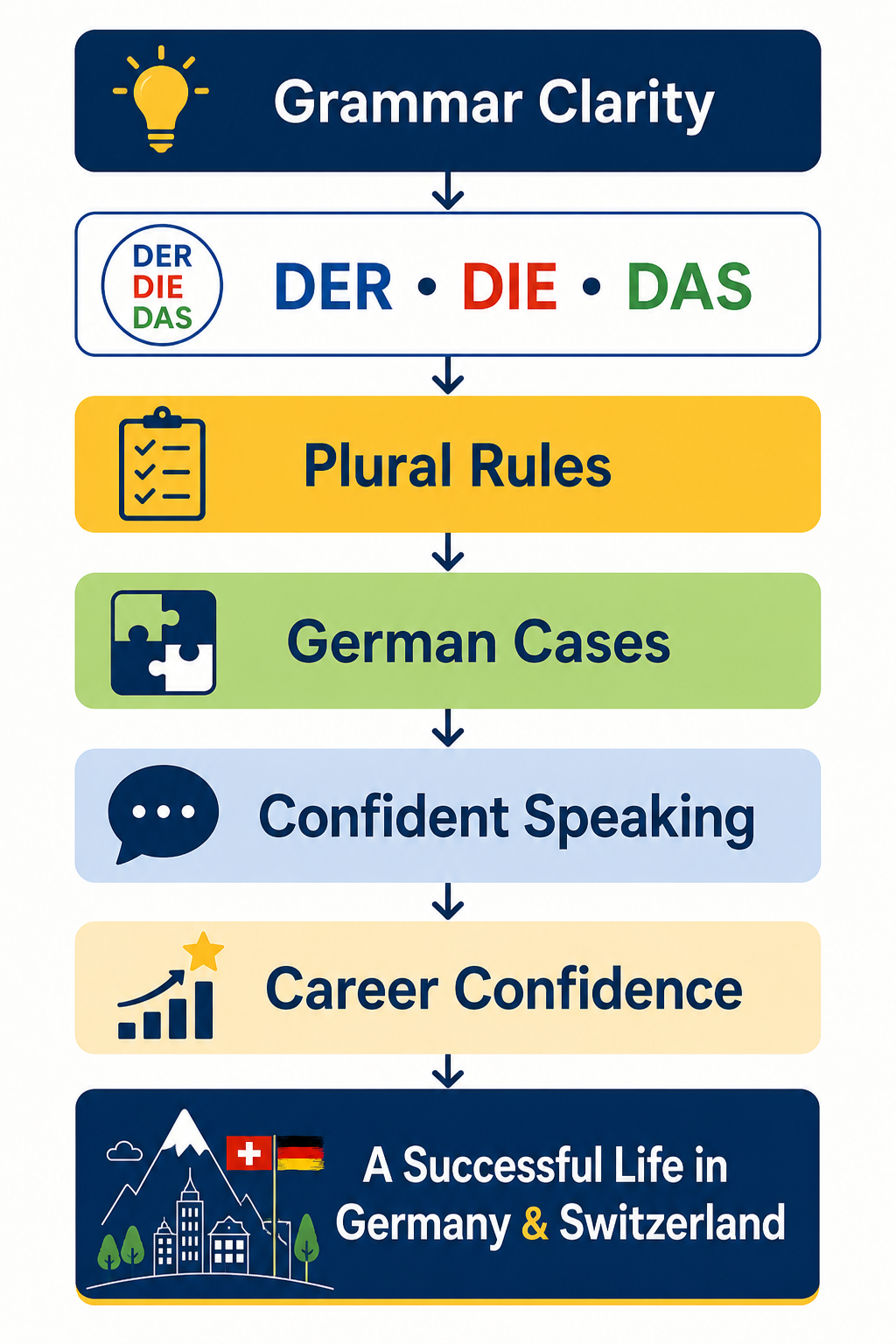
Every step gives you something to build on.
You don't have to master the whole path today.
You simply need to identify your next step.
And if you still understand DER, DIE and DAS while studying but forget them when you speak, strengthening that foundation is an excellent place to begin.
Ready to Make DER, DIE, DAS Easier to Remember?
You've now seen that the solution isn't necessarily learning more.
It may be learning what you already need in a clearer, more structured way:
✔️ article + noun
✔️ useful patterns
✔️ visual cues
✔️ plural forms
✔️ focused repetition
✔️ practical application
And I've turned those principles into a simple starting point for you.
🎁 Get Your FREE 5-Day DER, DIE, DAS Roadmap
Spend a few focused minutes each day building your foundation step by step.
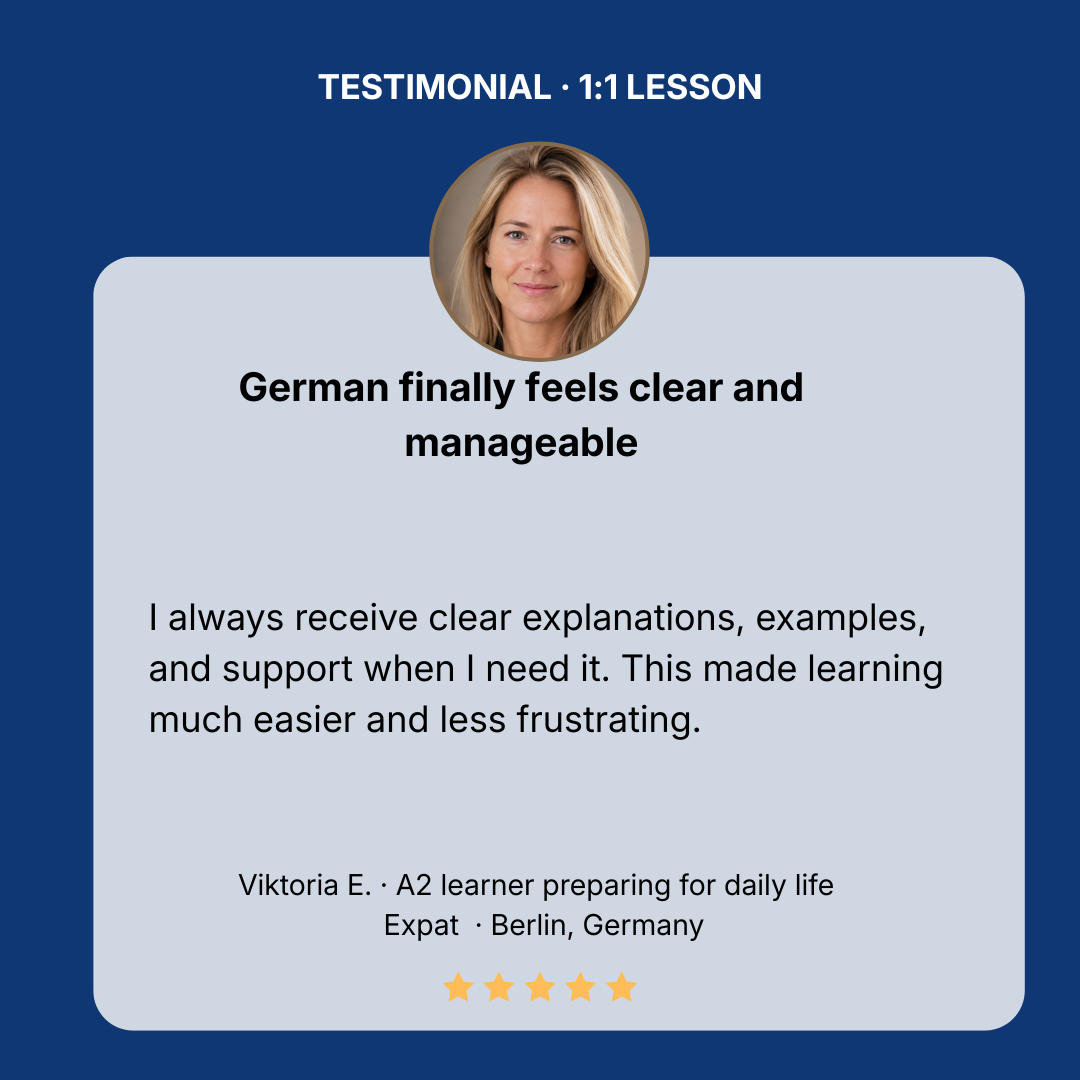
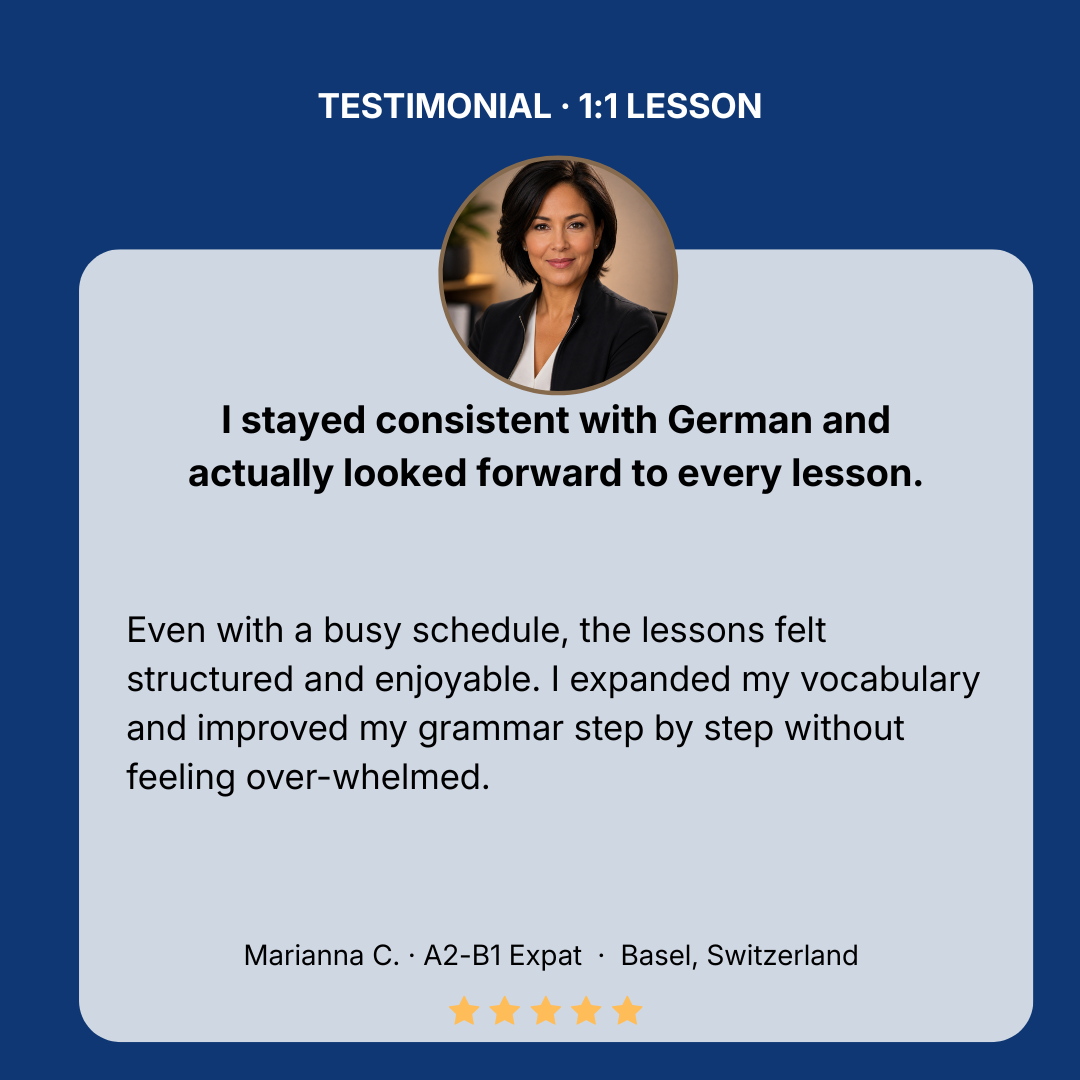

Your next step depends on how much support and structure you want.
Some learners begin with the free 5-Day DER, DIE, DAS Roadmap and practise at their own pace.
Others are ready to go deeper with more structure and guided practice.
Whichever path you choose, the principle behind my teaching remains the same: clear guidance, focused practice and calm, consistent progress.
And that brings me to the method behind my teaching.
A Calm, Structured Way to Build Confident German
Over the past 11 years, I’ve helped ambitious A1–B1 learners and expats build their German through a calm, structured approach that focuses on what really matters.
I’ve also learned foreign languages myself and lived abroad, where people did not speak my native language. I know how challenging it can feel when you want to communicate confidently, but the language still makes you hesitate.
That is why my teaching approach is built around:
- ✔️ clear grammar
✔️ focused practice
✔️ calm, structured learning
✔️ practical application for everyday life and work
Because German should not feel unnecessarily complicated.
It should give you the confidence to communicate, participate and move forward in your life in Germany or Switzerland.
Strong German begins with a clear foundation — and for many A1–B1 learners, der, die and das are an excellent place to start.
One of the Best Places to Start: DER, DIE, DAS
Articles are connected to so much of the German grammar that follows — from vocabulary and plural forms to the German cases.
That is why I created:
Der Die Das in 7 Days
The Fast Track to Gender Confidence
A calm, structured course for busy A1–B1 learners who want to stop guessing and build a stronger German foundation step by step.
Course Value: CHF 97
Your Price: CHF 47 (Approximately EUR 50 / USD 57)
Designed for busy A1–B1 learners in Germany & Switzerland.
Not Ready for the Course Yet? Keep Learning With Me 💫
You don't need to figure everything out at once.
Small, consistent steps can keep you moving forward — even with a busy schedule.
Join My Free Weekly Newsletter
Each week, I'll send you short, practical German guidance to help you:
☑️ understand grammar more clearly
☑️ improve your German step by step
☑️ communicate more confidently in everyday life and at work
☑️ keep learning without unnecessary overwhelm
What You'll Receive
📩 Clear German explanations
📩 Practical strategies you can apply
📩 Calm guidance for consistent progress
Your data are treated confidently, and only used by Deutsch A Beatrice.
Hi, I'm Beatrice — an experienced German teacher for ambitious expats. 😊I help busy A1–B1 learners in Germany and Switzerland build confident German for work and everyday life — with clear grammar, practical strategies and a calm, structured approach.